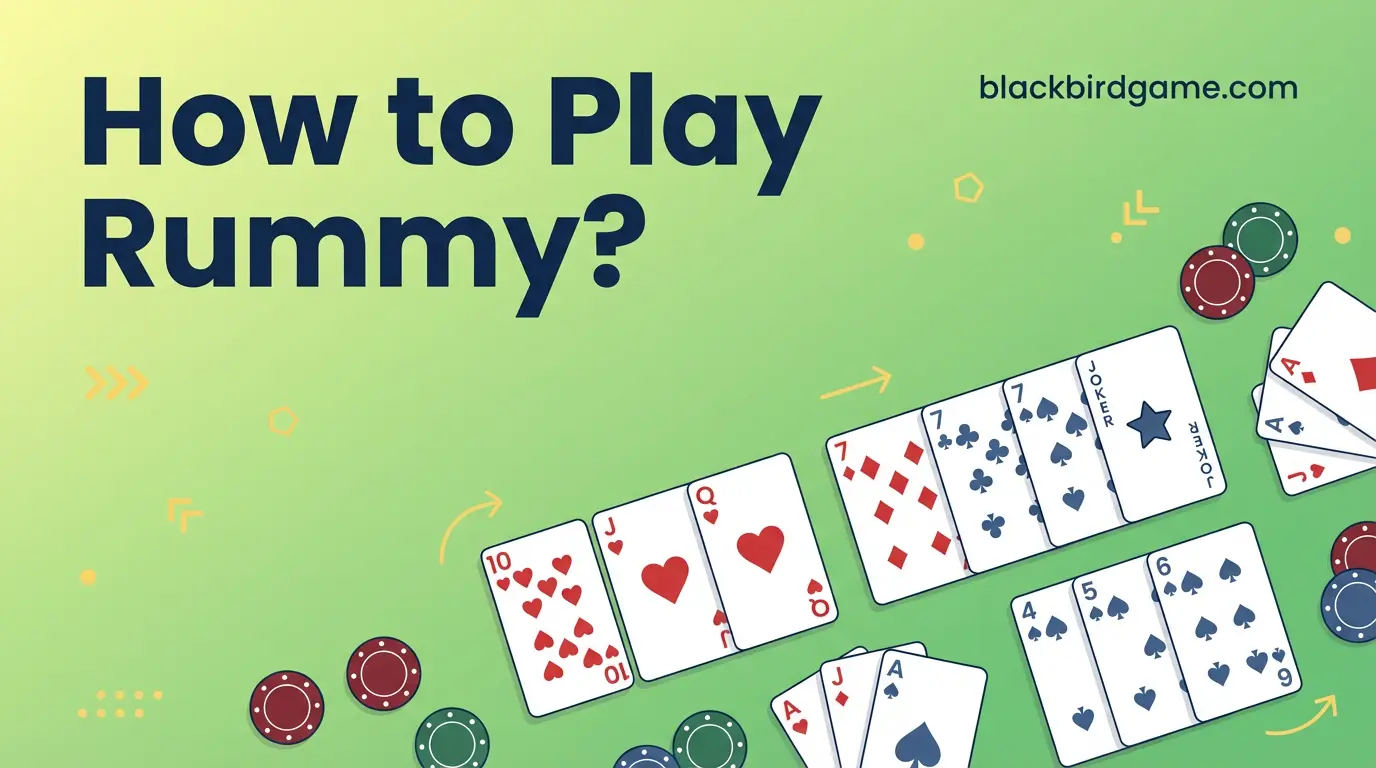
In every Indian household, from the busy streets of Mumbai to the quiet corners of Bangalore, learning how to play rummy is almost a rite of passage. It is not just a game; it is a test of “dimag” (intellect) and patience. The core objective is simple: arrange the 13 cards dealt to you into valid sequences and sets before your opponents do.
To win consistently, you must understand the balance between risk and reward. This guide provides a clear roadmap for beginners and intermediate players to sharpen their skills. Whether you are playing for fun at a family wedding or looking to boost your rummy earning on digital apps, mastering the foundational rules is the first step to becoming a “Rummy King.”
What are the Basic Rummy Terms?
Before you pick up the deck, you need to speak the language of the game. Using the wrong terminology can lead to confusion during a high-stakes match.
The Deck: Usually played with one or two standard decks of 52 cards plus printed Jokers.
Discard Pile: The pile where players place cards they no longer need.
Open Deck: The pile of discarded cards visible to everyone.
Closed Deck: The remaining cards face down.
Melding: The act of arranging cards into sequences or sets.
Declaration: When you have finished your melds and show your cards to end the round.
How Do You Play Basic Rummy?
To understand how to play rummy, you must first master the 13-card format, which is the most popular version in India. Each player is dealt 13 cards. One card is randomly selected as the “Wild Joker” for that round.
On your turn, you must pick a card from either the closed deck or the open deck. After picking, you must discard one card to the open pile. The goal is to form at least two sequences, one of which must be a Pure Sequence (cards of the same suit in order without a Joker). The remaining cards can be sets (three or four cards of the same rank but different suits).
Mastering the Rummy Rules 13 Card Format
The rummy rules 13 card system is strict about the “Pure Sequence.” If you declare without a pure sequence, you lose the maximum points (usually 80), even if your other cards are perfectly arranged.
Valid Melds Table
| Type of Meld | Description | Example |
| Pure Sequence | 3+ cards of same suit, no Joker | 5♠, 6♠, 7♠ |
| Impure Sequence | 3+ cards of same suit, with Joker | 4♥, 5♥, PJ (Joker) |
| Set | 3-4 cards of same rank, different suits | 7♣, 7♦, 7♠ |
A valid declaration must have:
- At least two sequences.
- One of these must be a Pure Sequence.
- The rest can be sequences or sets.
Different Player Dynamics: 2, 3, and 4 Players
The strategy changes significantly depending on how many people are sitting at the table. Your “chal” (move) depends on the cards you see being discarded by others.
How to Play Rummy with 2 Players
How do you play 2player on rummy? In a 2-player game, a single deck is usually enough. The game is incredibly fast. Since there is only one opponent, you can easily track which cards they are picking. If your opponent picks a 7 of Hearts from the open deck, you know exactly what they are building.
How to Play Rummy with 3 Players
With three players, the competition gets tighter. You have to monitor two discard patterns. It is often wise to play defensively here. If you don’t have a good starting hand with a potential pure sequence, a “First Drop” might save you points.
How to Play Rummy with 4 Players
This is the most common social format. Two decks are typically used. The chance of someone declaring early is much higher. You must be very careful not to discard “high cards” (A, K, Q, J) that might help your neighbors.
What are the Rules of 7 Card Rummy?
While 13-card is the boss in India, some regions prefer the quicker 7-card variant. So, what are the rules of 7 card rummy?
In this version, players are dealt only 7 cards. Because the hand is smaller, you usually only need to form two melds (one sequence of 3 and one sequence/set of 4). It is a high-speed game often played in casual “adda” sessions where time is short but the fun is high.
Expert Insights & PAA
Content Gaps
Most top-ranking pages focus purely on the rules but fail to explain the rummy earning aspect or the legal nuances in India. According to recent search trends, users are increasingly looking for “Skill-based gaming” status. In India, the Supreme Court has classified Rummy as a game of skill, not gambling, which is why platforms like RummyCircle or Junglee Rummy are so popular.
People Also Ask
Is Joker mandatory in a sequence? No, but it can be used to complete an Impure sequence.
What happens if I declare wrongly? You get 80 points (full penalty). Dhyan se (Be careful)!
Can I use two Jokers in one set? Yes, as long as the set remains valid with three or more cards.
4 Tips for Boosting Your Rummy Earning
If you are playing on apps for real prizes, you cannot rely on “naseeb” (luck) alone. Skilled players use specific tactics to ensure they stay in the green.
Discard High Points Early: Unmatched Kings, Queens, and Aces carry 10 points each. If they don’t fit a sequence by turn 3, drop them.
Use the Sorting Tool: Most Indian apps have a “Sort” button. Use it immediately to group your cards by suit and avoid confusion.
Baiting the Opponent: Sometimes, discarding a card you don’t need might trick your opponent into dropping a card you do need.
Watch the “Drop” Strategy: If your hand has no Joker and no sequences, dropping early costs only 20 points. It is better than losing 80.
Safe Gaming and Legal Status in India
When looking at how to play rummy for cash, always check the platform’s credentials. Legitimate apps are members of the E-Gaming Federation (EGF). Security is “sabse pehle” (first priority). Ensure the app uses SSL encryption and has a clear withdrawal policy to bank accounts.
Ready to Deal?
Learning how to play rummy is a journey of continuous improvement. From understanding the rummy rules 13 card to managing your rummy earning strategy, the game offers endless mental stimulation. Start with free tables to build your confidence, then move to small stakes once you have mastered the art of the Pure Sequence.
The beauty of Rummy lies in its social nature. Whether online or offline, it remains India’s favorite pastime. So, download a trusted app, verify your KYC, and let the cards do the talking!
About the Author